
Dive Deeper
2
Risk




While rare, right whales have been entangled in Maine gear. Here's how we know, and what it means for the fishery.
What do we know about Maine gear and right whales?
We know that right whale entanglement in Maine gear is extremely rare. Over the last 20 years, there is one known entanglement in Maine gear. Sadly, that whale was entangled in 2022 and died as a result of its injuries.
What don’t we know about entanglements?
Prior to 2022, gear marking was sparse and only identified gear by broad regions, so the majority of entanglements could not be traced to a specific fishery or location. Since 2022, gear marking has been expanded to identify each state, and inshore vs offshore gear. Canada followed suit implementing expansive gear marking requirements. This has increased the number of entanglements that are traced to a specific fishery or location. However, there remain cases in which enough gear is not recovered, or is broken, missing, or too degraded to determine the fishery or its origin. Because whales travel long distances in short amounts of time, it is also difficult to tell where a whale got entangled based on recent sightings. Not knowing where an entanglement occurred doesn’t mean there is no risk.
How does entanglement happen?
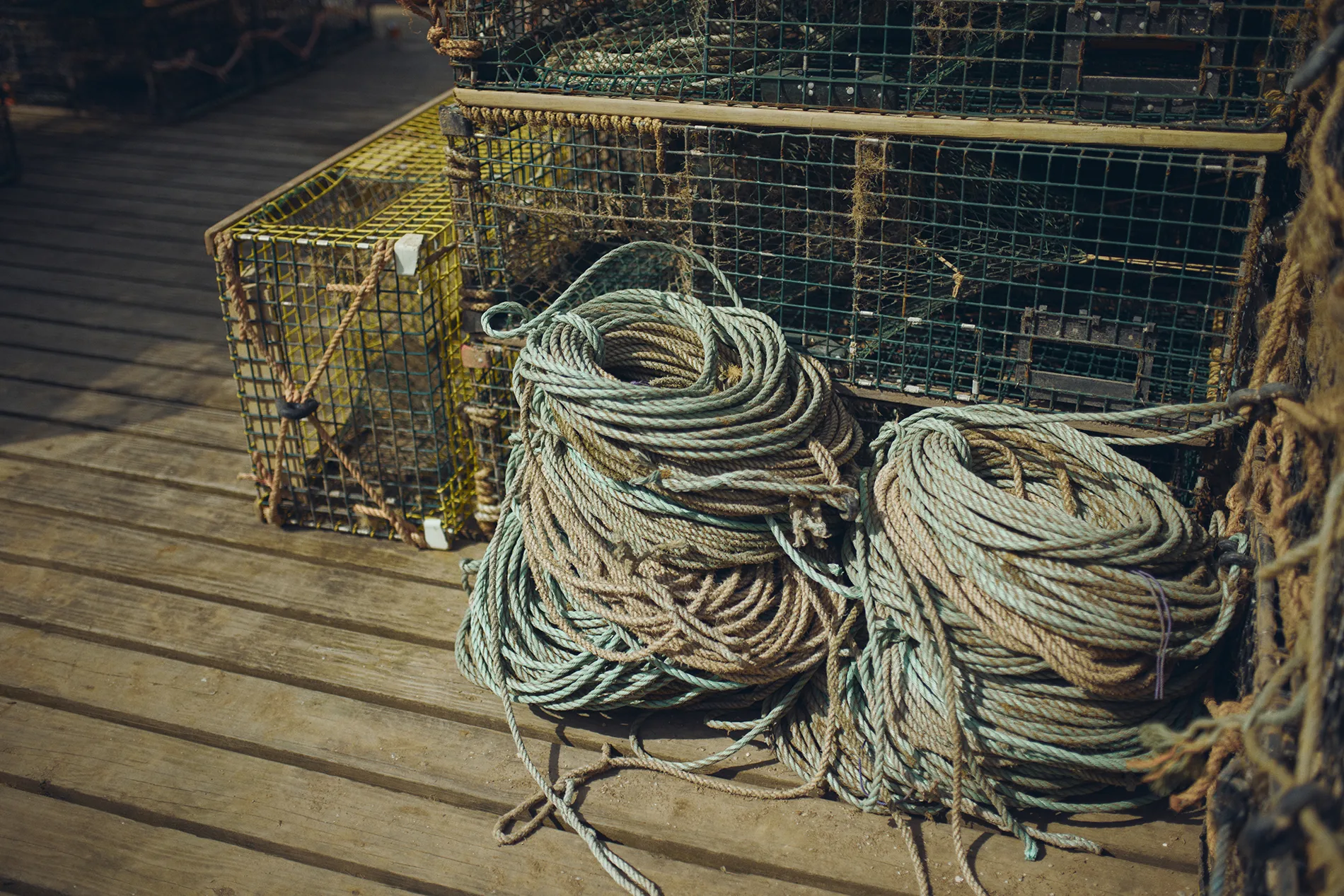
Researchers have not observed a right whale becoming entangled in fishing gear. Based on observed entanglements, researchers believe that when a right whale swims through areas where rope is in the water column, lines can get caught in the whale’s mouth, or wrapped around the flippers, or tail. A single line can progress to become a serious injury or death over time. That’s why regulations focus so heavily on reducing the number and strength of buoy lines in the water.
How is the risk reduction target calculated?
The risk-reduction target is based on the gap between the estimated number of right whales killed or seriously injured by U.S. fisheries and the number the population can lose and still recover. That allowable number is called Potential Biological Removal, or PBR. It is set under the Marine Mammal Protection Act.
Because the right whale population is so small, its PBR is less than one whale per year. During the last round of whale rules, NMFS used a PBR of 0.7 and estimated that U.S. fisheries caused more than six deaths or serious injuries each year. NMFS therefore concluded that fishery-related risk had to be reduced by 90 percent.
That leaves very little margin for additional deaths or serious injuries. It is also why the birth of 23 calves during the 2026 calving season was welcome news.
How is risk calculated?
Federal models estimate entanglement risk based on how much rope is in the water, how strong it is, where and when it is fished, and when right whales are likely to be present. The model estimates the overall risk from the fishery, not the risk from individual boats or specific incidents.
Maine lobster industry advocates argue that the federal model overstated the risk posed by Maine’s lobster fishery. Because Maine-specific information was limited, the model relied on assumptions about right whale presence and fishing activity in Maine waters. Since 2023, Maine DMR has been collecting detailed information about right whales and lobster fishing in the Gulf of Maine. This work is intended to improve how Maine’s fishery is represented in future federal risk models. Congress funded the research as part of the six-year pause that prevented the previously proposed rule from taking effect.
What changes have already been made, and have they helped?
We’ve all made a lot of changes to how we fish to reduce risk to right whales. These include weak links and weak rope designed to break under pressure, sinking groundline between traps to remove rope from the water, trawling up to reduce the number of buoy lines, seasonal closures, and Maine-specific gear marking.
These changes do reduce risk, but it is difficult to measure how much each change has helped. The right whale population has slowly increased since 2020, but it remains small. Since federal risk limits are tied to the size of the whale population, the model may determine that a further risk reduction is needed. That is why the issue has not gone away.
What we still don’t know
It is difficult to determine Maine’s contribution to the overall entanglement risk. Fortunately, Maine DMR is collecting data which reduces the uncertainty about how Maine gear is fished, and where right whales are relative to that gear, increasing the likelihood of a more realistic estimate of the risk the Maine lobster fishery poses to right whales.